
AI Voice Agent for Business Guide 2027: Setup, Rules, Costs
Wondering if an AI voice agent for business is worth it in 2027? Get plain answers on what it does, the rules, the cost factors and how to roll it out.
By Biz E-Agency Inc. TeamUpdated 17 min read
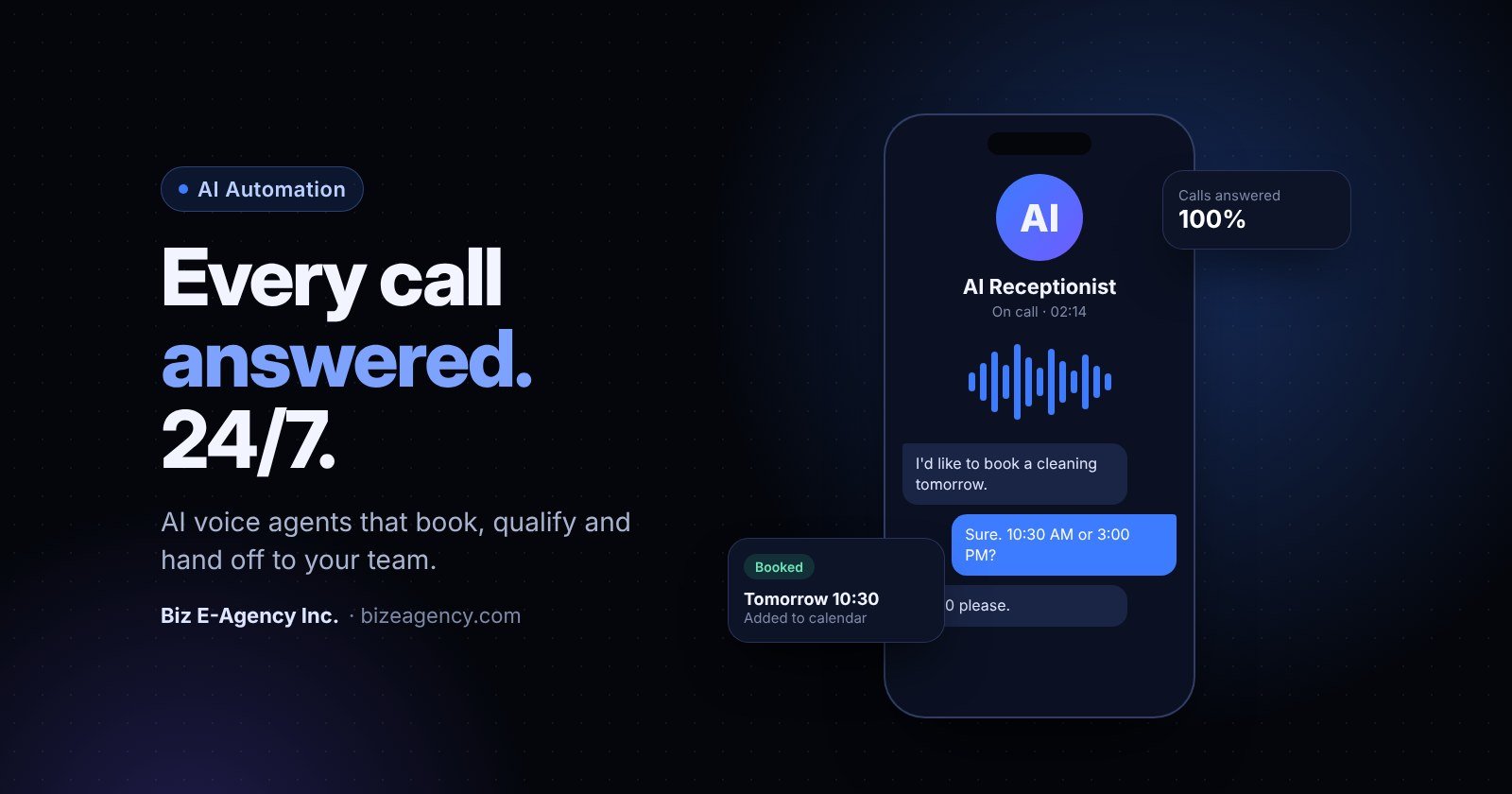
Quick answer: An AI voice agent for business is software that answers your phone calls in a natural voice, books appointments, qualifies leads and hands tricky calls to your team. In 2027 it is most useful for inbound calls: missed calls, after-hours calls and repeat questions. Start with two or three call types, tell callers it is an AI, and keep a human backup.
You probably have one question: will this actually work for my business? This guide answers it the way you would ask it. It covers what to automate, what to keep human, the rules to follow, what it costs and how to roll it out before you buy in 2027.
What is an AI voice agent for business?
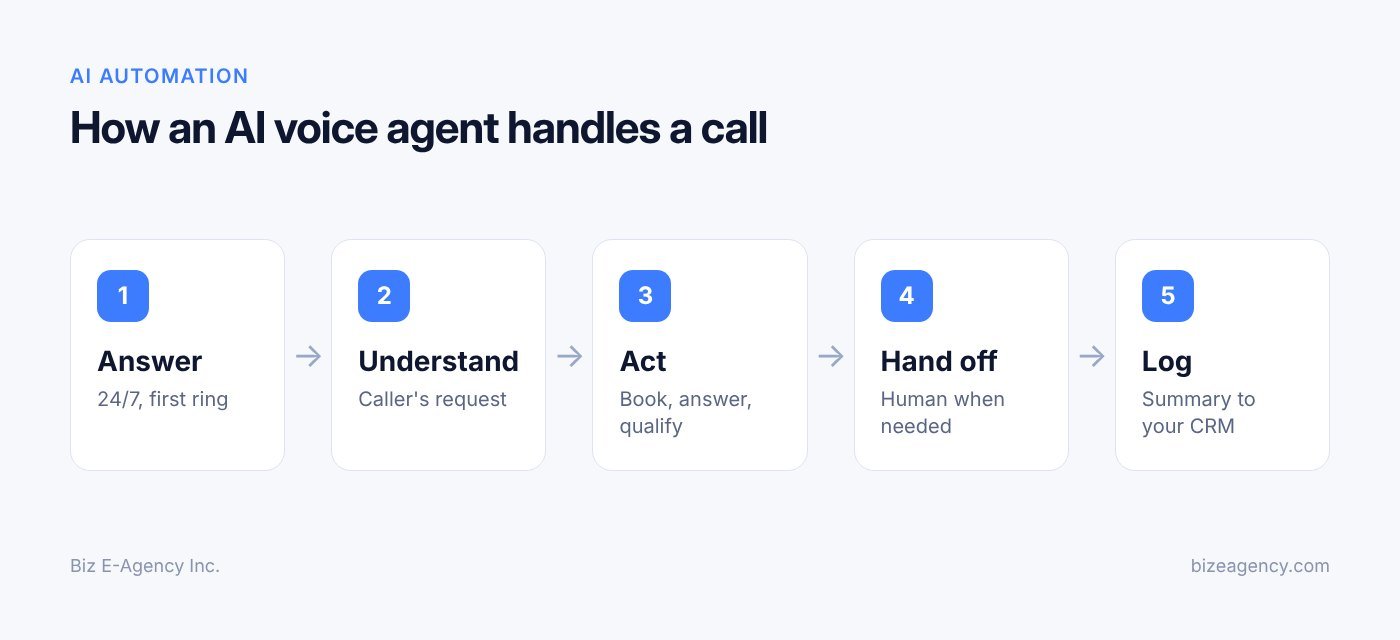
It is software that picks up a phone call, understands what the caller says and replies in a spoken voice. It is not a rigid menu. Instead of "press 1 for sales," your caller simply says, "I need to move my appointment to Thursday."
Behind the voice sit three parts. Speech recognition turns the caller's words into text. A language model works out the intent and decides what to do. A voice engine speaks the answer back. The agent also connects to your tools, such as a calendar, a CRM or a ticketing system, so it can act and not just talk.
What can it handle on a typical call?
- Greet the caller and ask how it can help.
- Answer common questions about hours, prices, services, location and policies.
- Check availability and book, move or cancel an appointment.
- Collect details such as name, phone number, address and the reason for the call.
- Qualify a sales lead by asking your standard screening questions.
- Send a text or WhatsApp confirmation after the call.
- Transfer the caller to a person when the situation calls for it.
What can it not do well?
It cannot replace judgment. A caller who is angry, grieving, confused or describing an emergency needs a human. A good agent recognizes those moments and steps aside quickly. We cover that handoff in detail below.
How is an AI voice agent different from an AI call center or a chatbot?
All three use AI to talk to customers, but each suits a different job. A voice agent works on phone calls, an AI call center runs many agents at once, and a chatbot works in text.
| Option | Channel | Best for | Main limit |
|---|---|---|---|
| AI voice agent | Phone calls | Answering, booking, screening, reminders | Needs careful tuning for accents and noisy lines |
| AI call center | Many calls at once, often inbound and outbound | Businesses with steady call volume and a support team | Needs clear rules, reporting and human backup |
| AI chatbot | Website, WhatsApp, social inboxes | Quick answers, lead capture, order status | Customers who prefer to talk will still call |
An AI call center is not a single robot. It is a setup where several AI voice agents handle calls in parallel, route them by topic, log every call, and hand difficult ones to human agents. Think of it as your phone desk, with the routine work done by software and the hard work done by your people.
Do you need to pick just one? Usually no. A common pattern is a voice agent for calls, a chatbot on the website and WhatsApp for messages, and one shared inbox where your team sees everything. Biz E-Agency builds all three through our AI automation service.
Where does an AI voice agent for business pay off first?
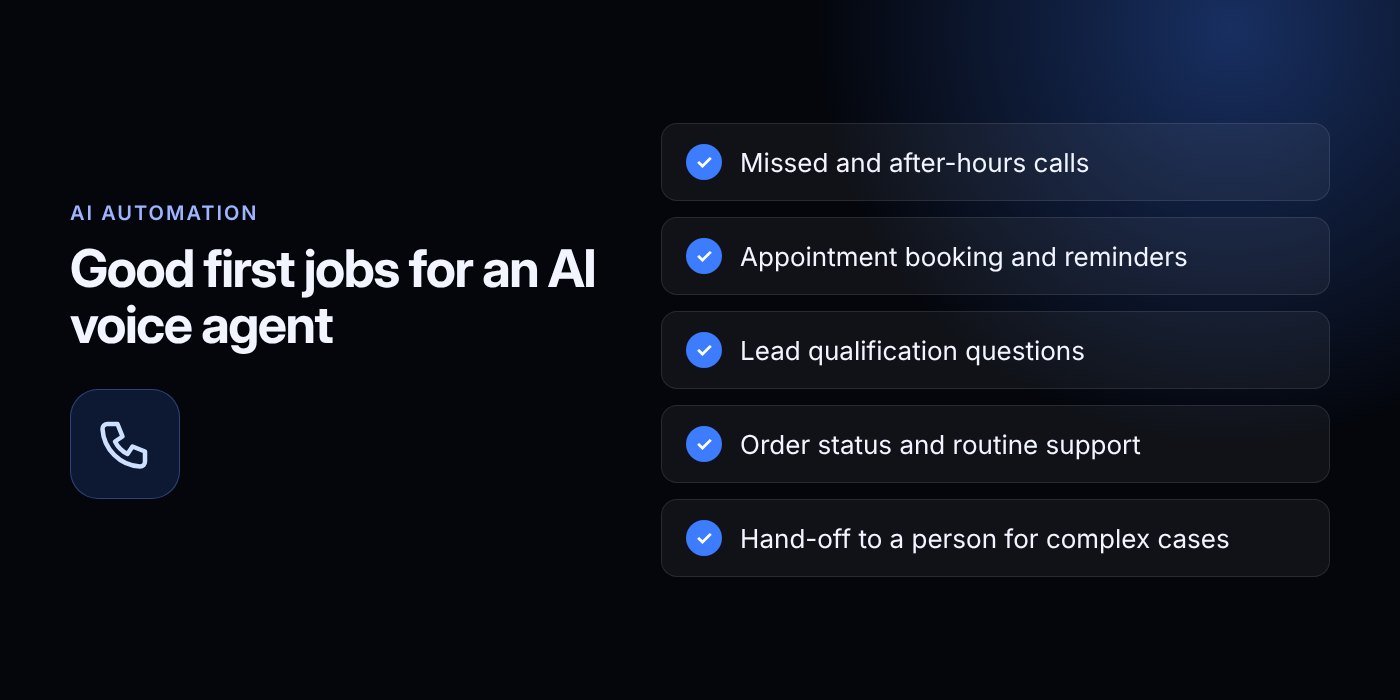
It pays off first where you already feel the pain. If you can say "we lose leads after 6 pm" or "our front desk spends half the day on the phone," you have a strong starting point.
Do missed calls and after-hours calls matter?
Yes. Many callers do not leave voicemail. They call the next business on the list. An agent that answers at 11 pm, on Sunday, or during a lunch rush keeps that caller in your pipeline. It captures the details and books a slot, so your team starts the morning with a list of ready leads.
Can it handle appointment booking and reminders?
Yes, and this is often the easiest win. Clinics, salons, repair shops, tutors, law offices and home service companies spend a lot of time on scheduling. The agent checks your calendar, offers open slots, confirms the booking and sends a reminder. Reminders can reduce no-shows, because the caller can reply to confirm or reschedule in seconds.
Can it qualify sales leads?
Yes. Not every inquiry deserves a salesperson's first hour. The agent can ask your screening questions: budget range, timeline, location, service needed. It then scores the lead and books a call with the right person. Your sales staff talk only to people who fit.
What about order status and routine support?
Questions like "Where is my order?" or "What are your hours on Friday?" make up a large share of calls in many shops. Connected to your POS or order system, the agent can answer them in seconds. If you run a restaurant or store, our Restaurant POS and Mart and Retail POS are examples of systems an agent can read from.
What happens during a rush or a seasonal peak?
A promotion, a storm, a holiday or a viral post can flood your phone line. Software scales to many simultaneous calls. A human desk does not. This is where an AI call center earns its place.
What should I automate, and what should stay with a human?
Automate calls that are repetitive, rule-based and low risk. Keep human any call that is emotional, high value or legally sensitive.
| Automate | Keep with a human |
|---|---|
| Opening hours, location, pricing lists | Complaints and escalated disputes |
| Booking, moving and cancelling appointments | Medical, legal or financial advice |
| Lead intake and screening questions | Negotiating large or custom deals |
| Order status and delivery updates | Refund exceptions and policy overrides |
| Appointment and payment reminders | Emergencies and safety issues |
| Post-call text with a summary or link | Sensitive news or bereavement |
How many call types should I start with?
Two or three. A narrow agent that handles bookings and hours well will earn more trust than a broad agent that handles everything badly. You can add topics every few weeks as the call logs show what callers really ask.
How do I find the best calls to automate?
Use your own call history. Before you build, list the top 20 reasons people call you. Your staff already know them. Count how often each one comes up and how long it takes. The calls that are frequent and short are the best candidates.
Is it safe to take payments or health details by voice?
Be careful. Taking card details over the phone brings payment security rules into play. A safer design sends the caller a secure payment link by text instead of having the agent collect card numbers. For clinics and similar businesses, treat health details as sensitive and collect only what you need. Ask your compliance adviser which rules apply in your country.
How well can an AI voice agent handle English, Urdu and Hindi?
It can work well, but accuracy depends on accents, line quality and vocabulary. For businesses in Pakistan, India, the UAE, the UK and Canada, language is often the biggest reason to use AI voice. Your customers may move between languages in a single sentence, such as Urdu with English words like "appointment" or "delivery."
What does good multilingual support look like?
- The agent greets in your default language and switches when the caller does.
- It understands mixed speech, such as Urdu with English terms.
- It confirms key details back to the caller, such as dates, times and phone numbers.
- It writes the call summary in a language your team reads.
Biz E-Agency works in English, Urdu and Hindi, and we build agents that follow the same setup. Always test with real callers before launch.
How can I get better results in any language?
- Write your script and knowledge base in natural spoken language, not formal written text.
- Add local names, place names and product names so the agent pronounces and recognizes them.
- Record test calls from different phones, including noisy ones.
- Ask native speakers on your team to rate the voice, pace and tone.
- Offer a quick route to a human who speaks the caller's language.
Numbers deserve extra care. Phone numbers, order numbers and addresses are where recognition errors cause the most damage. Have the agent read them back and ask for confirmation every time.
How do I hand a call to a human without losing the caller?
Tell the caller what is happening, pass a short summary to your team member, and never repeat the questions. The handoff decides whether callers trust your AI. A bad one makes the caller repeat everything. A good one feels like a warm introduction.
When should a call move to a person?
- The caller asks for a human, even once.
- The caller sounds frustrated, upset or confused.
- The agent fails to understand the same request twice.
- The topic is on your "human only" list, such as complaints, legal issues or refunds.
- The caller is a high-value customer or a known VIP.
What does a good handoff look like?
The agent says, "I will connect you to a team member now." It then passes a short summary: caller name, number, reason and what has already been collected. If nobody is free, the agent offers a callback time and logs it as a task.
What if nobody is online at night?
Decide in advance. Good options are to book a callback for the morning, send an urgent alert to an on-call phone, or direct emergencies to the right service. Never leave a caller in a dead end.
Should I tell callers they are talking to AI?
Yes. A short line such as "Hi, this is the virtual assistant for your clinic" is honest and sets expectations. In some places, rules on automated or artificial voices make disclosure a legal matter, not only good manners. More on that below.
Should I add a website chatbot and WhatsApp as well?
For most businesses, yes. Voice is one channel, and many customers would rather type, especially during work hours or on mobile data.
What does a website chatbot do?
It answers questions from your own content, captures contact details and books meetings. It works best when it is trained on your real pages, price lists and policies, and when it can pass the chat to your team. Keep its job small: answer, capture, book, hand off.
Why does WhatsApp matter?
In many markets, including Pakistan, India, the UAE and parts of the UK, WhatsApp is the main way customers contact businesses. The WhatsApp Business Platform (see Meta's Cloud API overview) lets you automate replies, with business verification and opt-in rules for messages you start. Meta approves message templates and charges for messages, and its rules and fees can change, so check the current terms. Our guide to the WhatsApp Business API explains the setup.
How do I keep every channel in one place?
Avoid running separate bots that do not talk to each other. A shared inbox lets your team see the call summary, the chat and the WhatsApp thread for the same customer. If you do not have a system for tracking customers yet, read our guide to CRM software for small business or look at our Business CRM.
What are the rules on call recording, consent and telemarketing?
They differ by country and by state, and they matter even for small firms. This is general information, not legal advice. Check the official sources and speak to a lawyer before you launch in 2027.
Do I need consent to record calls?
Some places allow recording if one person on the call agrees. Others require everyone on the call to agree. In the United States this varies by state, and calls often cross state lines, so many businesses play a notice at the start: "This call may be recorded and handled by an automated assistant." If a caller objects, offer a way to continue without recording or to speak to a person.
Outside the US, privacy laws such as the UK GDPR and similar rules in other countries treat call recordings and transcripts as personal data. You need a lawful reason to keep them, a retention period, and a way to answer access or deletion requests. Pakistan, the UAE and other markets have their own data protection rules, which are still developing, so confirm the current position locally.
What do the TCPA and FCC rules mean for AI calls in the US?
The Telephone Consumer Protection Act (TCPA) limits autodialed and prerecorded or artificial-voice calls and texts to consumers. The Federal Communications Commission (FCC) enforces it. In 2024 the FCC said that calls using AI-generated voices count as "artificial" voices under the TCPA. That means many AI outbound calls to consumers need the right kind of prior consent, usually in writing for marketing.
Key points to check:
- Inbound calls, where the customer calls you, are far lower risk than outbound marketing calls.
- Marketing calls using artificial voices generally need prior express written consent.
- The National Do Not Call Registry applies to many telemarketing calls, and you must keep your own internal do-not-call list.
- Calls have time-of-day limits, and callers must identify the business and offer a way to opt out.
- Consent records matter. Store when, how and for what the person agreed.
The FTC's Telemarketing Sales Rule adds further requirements for sales calls. It calls for a written agreement before telemarketing calls with prerecorded messages, an automated interactive opt-out, and generally limits calling hours to 8 a.m. to 9 p.m. The FCC and FTC sites have current guidance. Verify every point on the official sites, because rules and court decisions change.
What about the UK, Canada, the UAE and Pakistan?
In the UK, the Privacy and Electronic Communications Regulations (PECR) govern marketing calls, and the Information Commissioner's Office (ICO) publishes guidance on direct marketing calls, texts and email. Automated marketing calls generally need prior consent. Canada has the CRTC rules and a national do-not-call list. The UAE and Pakistan have their own telecom and consumer rules. If you call people across borders, follow the strictest rule that applies.
What safeguards should I put in place?
- Use AI voice mainly for inbound calls and for service calls to existing customers who expect them, such as appointment reminders.
- Do not use AI voice for cold outbound marketing unless a lawyer confirms your consent process.
- Disclose that the caller is speaking with an automated assistant.
- Honor opt-outs immediately and across all channels.
- Keep recordings only as long as you need them, and restrict who can listen.
- Keep a written record of your consent text and the date it went live.
How do I measure an AI voice agent for business?
Set a baseline before launch, then track a handful of numbers each week. If you cannot measure it, you cannot improve it.
| Metric | What it tells you | How to use it |
|---|---|---|
| Answer rate | Share of calls picked up | Should approach 100% at all hours |
| Containment rate | Calls fully handled without a human | Raise it slowly by adding topics |
| Handoff rate and reasons | Why calls go to staff | Find gaps in the script and knowledge base |
| Booking conversion | Calls that end in a booked slot | Compare with your old phone process |
| Lead quality | Share of AI-qualified leads that sales accepts | Tune the screening questions |
| Average call length | Efficiency and caller patience | Long calls often signal confusion |
| Caller satisfaction | Short post-call rating or survey | Watch trends, not single scores |
| No-show rate | Effect of reminders | Compare before and after |
| Cost per handled call | Value for money | Include software, minutes and tuning time |
Should I listen to real calls?
Yes. Numbers show where to look. Recordings show why. Review a sample of calls every week in the first month, then every month. Look for misheard words, awkward pauses, wrong answers and cases where the caller wanted a human sooner. Fix the script and the knowledge base, then test again.
What results should I expect?
Be honest about the baseline. A new agent usually needs a few rounds of tuning. We do not promise specific results, because they depend on your call types, your data and your team. Measure your own numbers and decide from those.
How do I set up an AI voice agent step by step?
Follow a careful rollout instead of a big-bang launch. These six steps work for most small businesses.
- Define the goal and the scope. Write one sentence: "We want the agent to answer all after-hours calls and book appointments." List the call types in scope and the ones that always go to a human. Name an owner on your side who decides what the agent may say.
- Prepare your knowledge. Gather the facts the agent needs: services, prices, hours, locations, policies, FAQs and booking rules. Keep them in one clean document and remove outdated items. An agent is only as accurate as the information you give it.
- Connect your tools. Link the calendar, CRM, POS or helpdesk so the agent can read and write real data. If you do not have these tools, this is the moment to consider them. Our software range and custom software development work cover this gap.
- Build, test and tune. Design the call flow, the voice and the handoff rules. Then run test calls, including odd ones: interruptions, accents, silence, wrong numbers and angry callers. Ask staff and friendly customers to try it.
- Soft launch. Start with a small slice: after-hours only, or one phone number, or one branch. Review calls daily at first and keep a human backup ready. Tell your team what the agent does so they are not surprised by transferred calls.
- Expand and maintain. Once the numbers look healthy, add call types, languages or channels. Update the knowledge base whenever prices, hours or policies change, and plan a monthly review.
Our projects include handover, training and a support window, and monthly maintenance plans are available. For a sense of how we deliver work in general, see our projects and our about page.
How much does an AI voice agent cost?
There is no single price. Cost depends on these factors:
- Call volume and how many calls run at the same time.
- The languages you need, such as English, Urdu and Hindi.
- The number of integrations, such as calendar, CRM, POS or WhatsApp.
- How much custom work the call flow needs.
- Ongoing tuning, reporting and maintenance.
We confirm pricing in writing before work starts, and payments are split into milestones. Ask for a quote based on your call types and volume, so you can compare it with the cost of missed calls and staff time.
How long does setup take?
As a rough estimate, a focused voice or chatbot setup can be ready within a few weeks, while a larger build with many integrations takes longer. Timelines depend on how quickly your knowledge and tools are ready. We confirm timelines during the discovery stage.
What mistakes should I avoid?
- Automating too much at once. Start narrow and grow.
- Hiding the AI. Callers notice, and some laws require disclosure.
- No human fallback. Every call needs an exit to a person or a callback.
- Poor source data. Wrong prices in the knowledge base mean wrong answers on the phone.
- Ignoring consent. Recording and outbound calling rules apply even to small firms.
- Skipping the review loop. The first version is never the best one.
- Measuring only cost. Track bookings, lead quality and caller experience too.
What will change in 2027 and 2028?
Nobody can predict this exactly, so treat the points below as things to watch, not promises. The direction is fairly clear, though.
Will voices and understanding keep improving?
Expect AI voices to keep sounding more natural and to handle interruptions, accents and mixed languages better. Expect more tools to offer Urdu and Hindi support. Still, plan to test with your own callers, because general progress does not guarantee good results on your phone line.
Will the rules get stricter?
Likely, in at least some places. Regulators in several countries have already shown interest in AI voices, consent and data protection. Watch for updates from the FCC, the FTC, the ICO and your local regulator, and review your consent wording at least once a year.
Will more customers expect instant answers?
Expect customer patience for unanswered calls to stay low. Callers who are used to instant replies on WhatsApp and chat will compare your phone line with those channels. A business that answers fast, in the caller's language, is likely to stand out.
Will voice, chat and business systems connect more tightly?
Watch for agents that act across your calendar, CRM, POS and messaging tools in one flow. That makes a good foundation more valuable: clean customer data, a clear knowledge base and a shared inbox. If you build these now, you can adopt new features in 2028 without starting over.
What should I check before I buy in 2027?
- Can you export your call logs, transcripts and customer data?
- Do you own the scripts, designs and code once you have paid in full? (With Biz E-Agency, the client owns the code and designs once paid in full.)
- Can the agent hand off to a human and log a callback?
- Does the setup support the languages your callers use?
- Is there a clear plan for recording notices, consent and data retention?
Next steps
Where should you begin? With a simple audit. Pull your call log for the last month. Count missed calls, after-hours calls and the top repeated questions. That gives you a clear case, and a clear first scope for your AI voice agent for business.
Then talk to us. Biz E-Agency builds AI voice agents, AI call center setups and AI chatbots, and can connect them to your website, WhatsApp and business systems. Read more on our AI automation page and see our wider services.
Ready to plan your rollout for 2027? Contact our team by email at info@bizeagency.com, on WhatsApp at +1 321-318-8127 or by phone at +1 650-502-9475. We work in English, Urdu and Hindi, and we will help you choose the first calls to automate. If you also want to grow your social channels alongside your phone line, see our social media management guide.
Frequently asked questions
Is an AI voice agent worth it for a small business?
It usually is when you lose calls after hours or your staff spend hours on repeat questions. Count your missed calls and top call reasons for a month first. If those numbers are high, a focused agent is likely to pay for itself in saved time and booked appointments.
Will callers hate talking to an AI?
Most callers care about getting a fast, correct answer. Be open that it is an AI, keep the voice clear, and let people reach a human with one request. Frustration usually comes from dead ends, not from the AI itself.
Can the agent work with my calendar and CRM?
Yes, that is what makes it useful. Connected to your calendar, CRM or POS, it can check real availability, log the lead and send a confirmation. Tell us which tools you use and the team confirms what can be connected.
Do I own what you build for me?
With Biz E-Agency, the client owns the code and designs once the project is paid in full. Pricing is confirmed in writing before work starts, and payments are split into milestones. Handover, training and a support window are included.
Can I use an AI voice agent for outbound sales calls in the US?
It is risky. The FCC has said AI-generated voices count as artificial voices under the TCPA, so marketing calls generally need prior express written consent, and Do Not Call rules apply. Verify the current rules on the official FCC and FTC sites and get legal advice first.
How long does it take to go live?
A focused setup can often be ready within a few weeks, while larger builds with many integrations take longer. Timelines depend on how ready your knowledge base and tools are. The team confirms a timeline during the discovery stage.
Need help putting this into practice?
Tell us what is slowing your business down. We reply within one business day with a clear fix.