
Companies House Compliance Software Guide 2027: How to Choose
Not sure which Companies House compliance software to pick in 2027? Here are plain answers on deadlines, penalties, Gazette notices and what to check first.
By Biz E-Agency Inc. TeamUpdated 19 min read
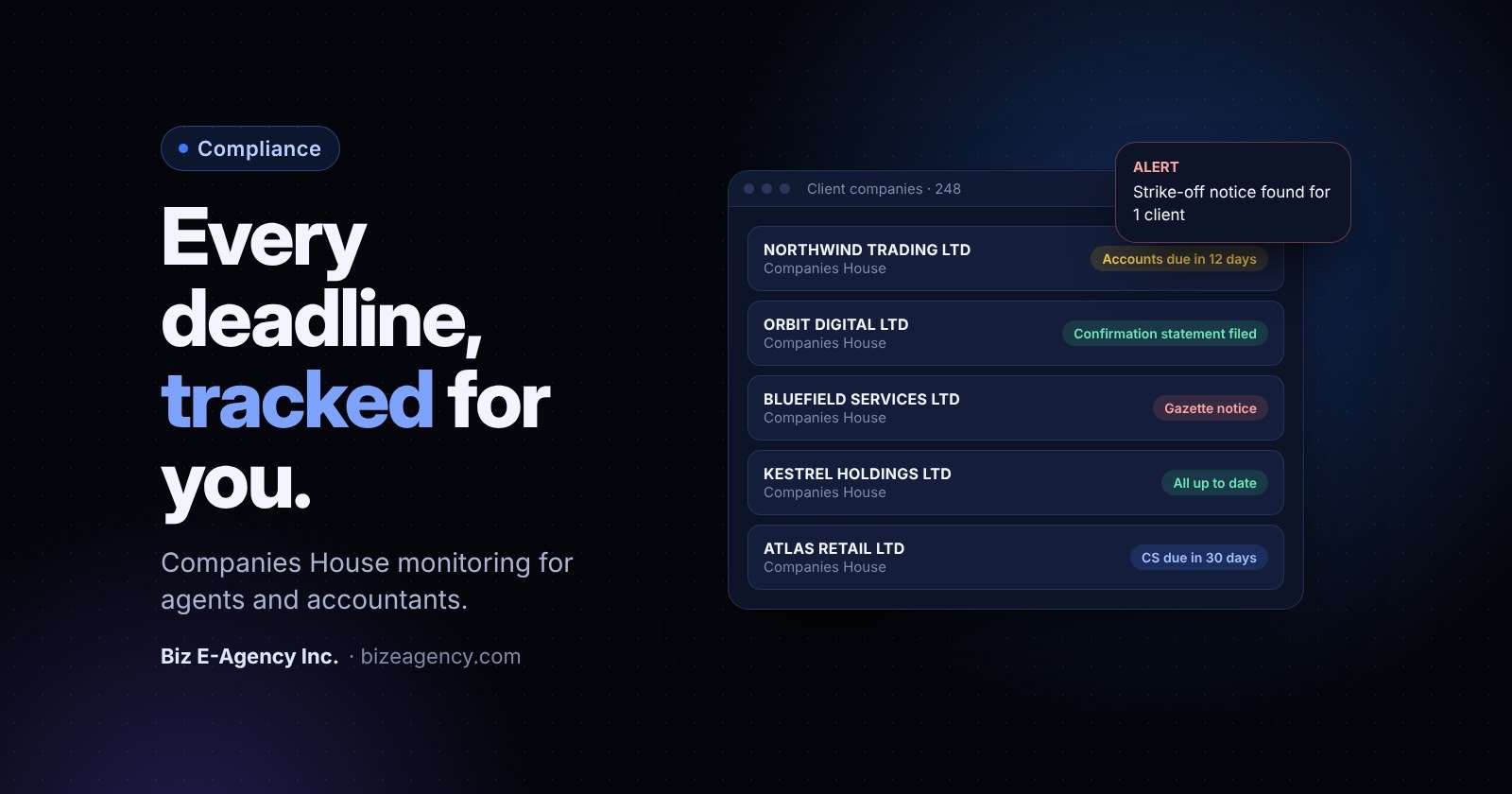
Quick answer: Companies House compliance software is a tool that reads the public register for each of your client companies and warns you before a confirmation statement, accounts deadline or strike-off notice becomes a problem. If you look after more than a handful of UK limited companies, it is worth having in 2027. Pick one that syncs with the official register, flags Gazette and default address changes, and sends alerts to a named person.
You manage UK limited companies for clients, and a missed date lands on you, not them. Companies House compliance software gives you one live view of every filing, status change and notice. This guide is for formation agents, accountants and company secretaries who want to know what to check before they buy in 2027, and how to run the tool once it is in place.
We keep it practical. Where rules change often, we point you to gov.uk instead of quoting dates that may be out of date.
Why is tracking Companies House deadlines so hard at scale?
Short answer: Because every company has its own dates, and a single slip in a busy week is enough to cause a penalty. One company is easy. Hundreds of companies are a different job.
With one company you know the year end, you diarise the dates and you file. At 50 or 500 companies, each with its own accounting reference date, review period and officer list, the work changes shape.
The risk is rarely that you do not know the rules. The risk is that a date slips, or that a notice sent to a registered office never reaches anyone who reads it.
Who pays when a date is missed?
You do. Clients blame the person they paid to look after the company. Penalties, strike-off warnings and restoration paperwork all create unbilled work and damage trust.
Common failure points in practice teams:
- Dates held in personal calendars that leave with a staff member.
- Spreadsheets updated only when someone remembers.
- Reminders based on the incorporation date, when the real date moved after a change of accounting reference date.
- Notices sent to a registered office address the client no longer controls.
- Clients who file for themselves and never tell you.
Why do manual checks stop working?
Checking the public register one company at a time takes minutes per company. Repeat that every month across a client book and it becomes hours of low-value work, with a high cost for a single miss.
The public register is the source of truth. Your own records are only a copy. Any process that relies on someone remembering to compare the two will eventually fail.
What filings must a UK company keep up with?
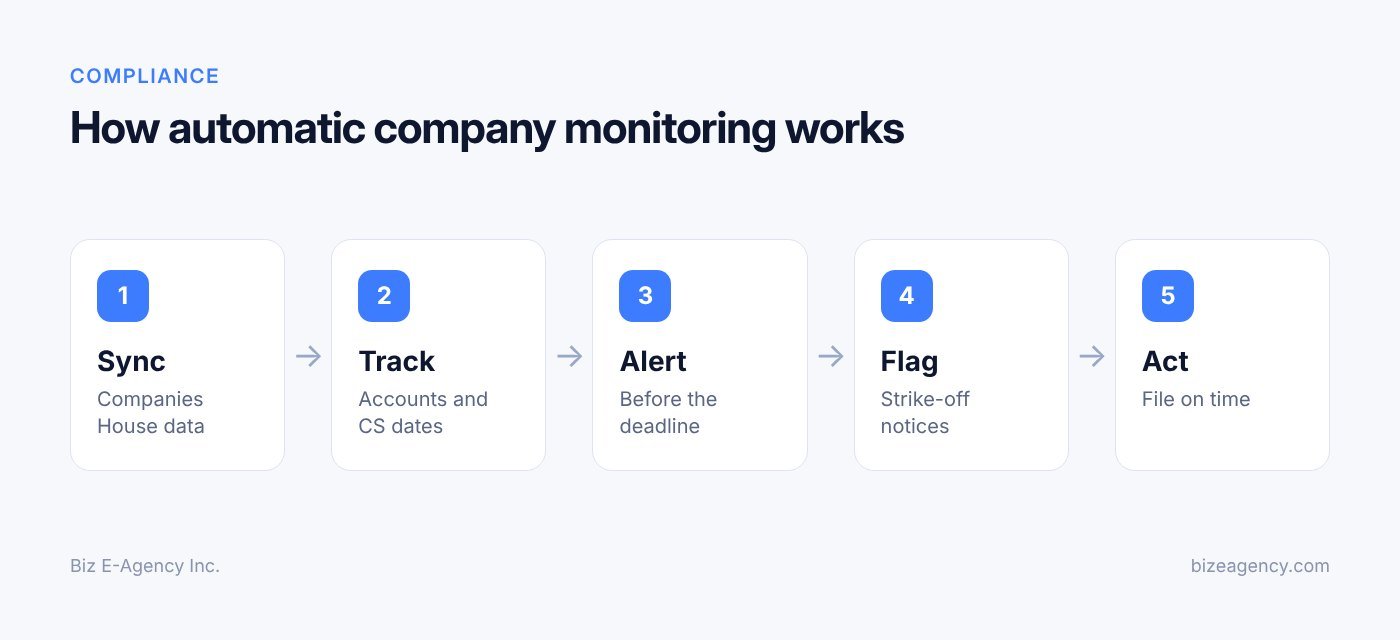
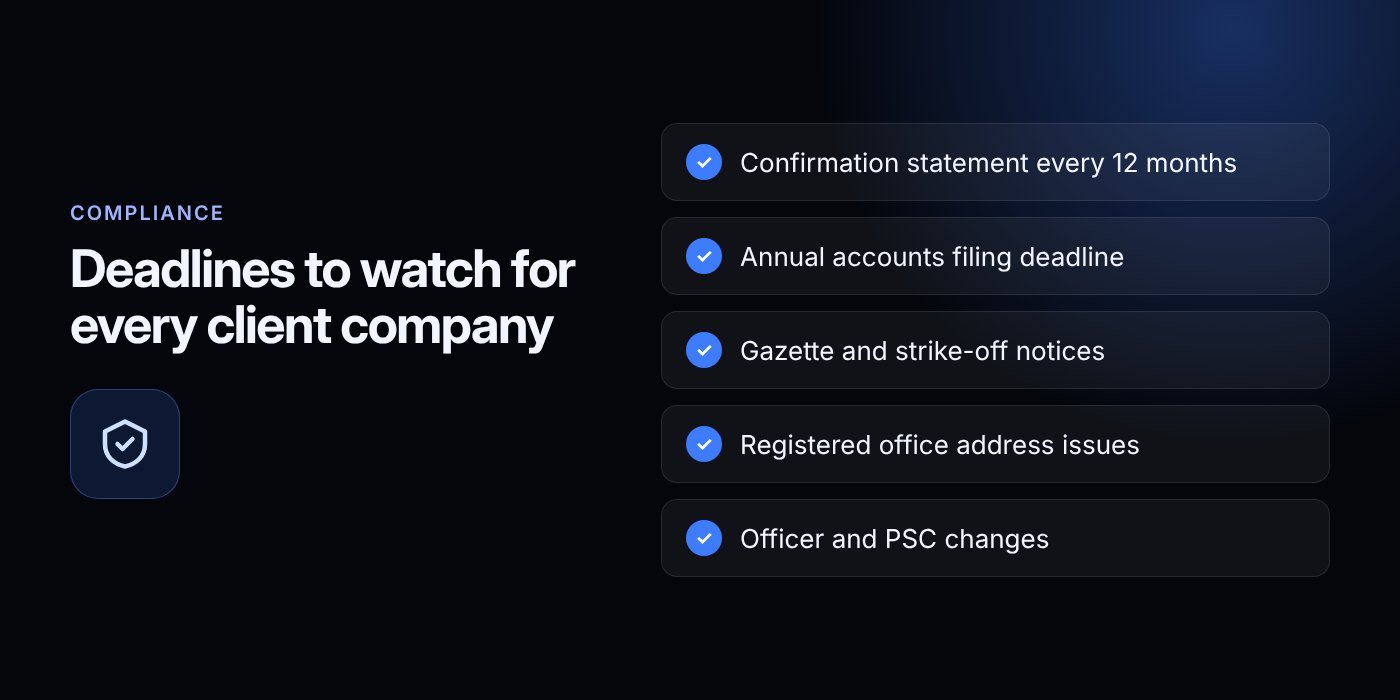
Short answer: At a minimum, a yearly confirmation statement, annual accounts, and timely updates when officers, people with significant control (PSC) or the registered office change. Your software must track all of these.
Before you choose a tool, be clear on what it has to watch. These are the recurring obligations for a typical private limited company.
What is a confirmation statement?
It is a yearly check that the information Companies House holds about the company is correct. It must be filed at least once every 12 months, within 14 days after the end of the review period.
The statement confirms details such as the registered office, officers, shareholders and business activity. If anything has changed, it must be updated. Fees and process are set on gov.uk, so check the current guidance before you quote a cost to a client.
Do all companies have to file annual accounts?
Yes, even dormant ones. The due date depends on the accounting reference date and on whether it is a first set of accounts, so read it from the company record instead of working it out from memory.
Companies House guidance on annual requirements is on gov.uk: life of a company: annual requirements. That page also covers a change in how accounts are submitted, which we cover below.
What about officer and PSC changes?
Directors, secretaries and PSCs must be kept current on the register. Appointments, resignations and changes of details each have their own filing requirement, separate from the yearly statement.
Missed officer updates are a common reason a confirmation statement becomes harder to file. Your tool should show officer changes as they appear on the register, so your team can compare them with what the client told you.
Which other events need a filing?
Some events are not on a yearly cycle but still need action: a change of registered office, a share allotment, a change of company name or a registered charge. No tool can predict these, but a good one makes the recent filing history easy to read, so you can see what changed and when.
How much are late filing penalties for annual accounts?
Short answer: For a private company, gov.uk lists penalties from £150 to £1,500, depending on how late the accounts are. The penalty is doubled if accounts are late two years in a row.
According to gov.uk guidance on penalties for late filing of annual accounts, the amount depends on how late the accounts are:
| How late the accounts are | Penalty for a private company |
|---|---|
| Up to 1 month | £150 |
| 1 to 3 months | £375 |
| 3 to 6 months | £750 |
| More than 6 months | £1,500 |
The penalty is doubled if the accounts are late two years in a row. Always confirm current amounts on gov.uk before you quote them, because the figures can be changed.
Why are penalties a practice-management problem?
A single £150 penalty is annoying. Six months of delay plus a repeat offence is a serious bill. Across a client book, the real cost is the time spent on appeals, explanations and difficult conversations.
The goal of Companies House compliance software is not to avoid learning the rules. It is to give you enough warning that accounts are prepared, approved and filed well before the due date.
How has the way accounts are filed changed?
Companies House guidance states that the WebFiling service for accounts closed on 31 March 2026, and most accounts must now be filed using commercial software. Further changes are scheduled for 1 April 2028. Read the Companies House annual requirements guidance for the current position.
For your practice, this matters in two ways. First, your accounts production tool must be able to file directly. Second, your monitoring tool should clearly show when accounts were filed and accepted, so you are not relying on a confirmation email that went to the wrong inbox.
When is my confirmation statement due?
Short answer: It must be filed at least once every 12 months, within 14 days after the end of the review period. The exact date moves if you file early, so trust the date on the register.
Confirmation statements look simple, but they are among the most missed filings. The date changes each year, and many small companies treat them as an afterthought.
How does the review period work?
The 12-month review period starts from incorporation or from the end of the previous review period. The statement must be filed within 14 days after the end of that period. You can file earlier, which resets the next cycle.
Teams that diarise "same date next year" get caught when a client filed early, because the next due date shifted. Tracking from the register avoids that problem, which is why good software reads the due date from the record.
What should I check with the client before I file?
- The registered office address is correct and documents will reach the company there.
- The list of officers matches the register, including service address details.
- Shareholder and share capital information is current.
- The PSC information is accurate.
- The SIC code still describes what the company does.
Why do late confirmation statements matter so much?
Failing to file one can lead to compulsory action against the company and its officers. That is more serious than a late-accounts penalty because it can end with the company being removed from the register. Give this deadline the same weight as accounts.
What does a Gazette strike-off notice mean?
Short answer: It means Companies House has started the process of removing the company from the register. The first notice is a warning, and fixing the underlying problem can stop it.
When a company stops filing or stops responding, Companies House can start to remove it from the register. This is called being struck off, and it is announced in The Gazette.
How does compulsory strike-off work?
If the registrar has reason to think a company is no longer carrying on business, or if required documents are not filed, a notice can be published in The Gazette. The company is given time to respond. If nothing changes, a later notice can lead to dissolution.
The timelines are set by Companies House and published on gov.uk. The practical point is that the first notice is not the end. Companies that notice it early can usually fix the filing problem and avoid dissolution.
What is voluntary strike-off?
Directors can apply to strike a company off themselves. The official guidance on striking off your company from the register sets out the rules. For example, a company that has traded in the last three months generally cannot apply. After strike-off, company bank accounts are frozen, and a company can be restored later through a separate process.
Clients sometimes ask for a strike-off to "tidy up" and forget open liabilities. Make sure they understand what happens to money, contracts and creditors before the application is made.
What happens after dissolution?
Once a company is dissolved, its assets can pass to the Crown as ownerless property in certain cases. A company can be restored to the register, but that takes a court or administrative process, costs money and takes time. It is far cheaper to prevent the notice than to repair the result.
Why do I need software to watch the Gazette?
Gazette notices are public, but nobody on your team reads The Gazette daily for 300 company names. A tool that watches company status and flags a strike-off action gives you the earliest practical warning. It also gives you a documented trail showing that you spotted the notice and told the client.
What is a registered office default address?
Short answer: It is a Companies House address that the registrar can place on a company's record when its registered office is not appropriate or has not been corrected. Mail then may not reach your client.
Every UK company must have a registered office address, and it must be a real place where documents can be delivered. Official post from Companies House and HMRC goes there.
What counts as an appropriate address?
Registered office rules were tightened under recent reforms. The address must be one where documents sent to it are expected to come to the attention of a person acting for the company, and where delivery can be recorded. Check the current guidance on gov.uk, because the details and the dates of changes are published there.
Why is a default address a warning sign?
If Companies House has reason to think an address is not appropriate, or the company has not updated it, the registrar can move the company to a default address. It is a holding position, and the company is expected to correct it.
Post may not reach the client, and the company may miss other notices without knowing. If you act as agent for the registered office, you need to see this status change immediately.
What causes default addresses in agent portfolios?
- A client moves premises and forgets to file the change.
- A virtual office or mail-forwarding arrangement ends.
- An address supplied by a third party stops passing on mail.
- An address was used in error during formation.
If you run an address service, keep a clear record of which clients use it, and alert them when the register shows a status you did not expect.
What did the Economic Crime and Corporate Transparency Act change?
Short answer: It reformed how UK companies are registered and monitored, and it is being phased in. Check gov.uk for current dates and procedures before you advise a client.
The Economic Crime and Corporate Transparency Act 2023 (often shortened to ECCTA) affects agents and accountants directly. Rather than quote dates that can change, here are the themes to know:
- Registered office rules: the address should be a genuine, appropriate one.
- Company email addresses: companies are expected to provide an appropriate email address for official communications.
- Identity verification: identity checks for directors and PSCs are being phased in.
- Registrar powers: Companies House has more power to query, challenge and remove information on the register.
- Agent obligations: people who file for companies, such as formation agents and accountants, face additional requirements.
Where should I check dates and fees?
On gov.uk, or on the Companies House news and guidance pages. Dates, fees and procedures have been published in stages. Do not rely on a blog post, including this one, for exact dates.
What does this mean for my tooling?
More data to track and more events that can affect a company's status. Software that syncs with the register keeps you close to the real position without someone checking each company by hand after every reform.
What will change in 2027 and 2028?
Short answer: Expect more of the reform work to keep reaching practices, and expect accounts filing to keep moving to software. We cannot give you exact new dates here, so treat gov.uk as your calendar.
One dated fact is already published: Companies House guidance says further changes to accounts filing are scheduled for 1 April 2028. Beyond that, we can only describe what to watch for.
What should I watch for in 2027?
- Further stages of the identity verification and agent requirements under ECCTA. Watch the Companies House announcements for timing.
- Changes to how your accounts production software files with the register, as the end of WebFiling for accounts beds in.
- More attention on registered office and email address accuracy, so default address cases may be worth monitoring closely.
- Fee and process updates on gov.uk. Fees are likely to be reviewed from time to time, so never hard-code a fee into a client quote.
How can I prepare my practice?
Keep your client data clean, with correct company numbers, officers and contact details. Choose a tool that can add new alert types without a rebuild. And agree who in your team reads Companies House announcements, so changes do not depend on luck.
Will software choices matter more for 2028?
Probably. If more of the filing process moves to commercial software, then your accounts tool and your monitoring tool will need to work well together. When you compare vendors in 2027, ask how each one handles updates to the register's rules, and how quickly they release changes.
What should Companies House compliance software do?
Short answer: Keep your view of every client company aligned with the public register, and tell you early when something needs action. That is the core job. Everything else is a bonus.
Not every tool labelled "compliance" is useful to a practice. Use this table to check the features that matter.
| Feature | Why it matters |
|---|---|
| Live sync with the register | Your data matches the public record, not your last manual update |
| Confirmation statement dates | The single most missed recurring deadline |
| Accounts due dates | Avoids automatic late filing penalties |
| Officer and filing history | Shows what changed and when |
| Strike-off and Gazette flags | Early warning before dissolution |
| Default address alerts | Shows when mail may not reach the client |
| Alerts and reminders | Tells the right person before the date, not after |
| Search across registers | Useful when clients also have overseas entities |
Where should the data come from?
From the official Companies House API. The Companies House developer hub describes the API, which provides live data about UK limited companies. That is the right foundation: data from the register itself, not screen scraping or manual entry.
What should I ask a vendor before I buy in 2027?
- Does it pull status, officers and filing history from the official API?
- How often does it refresh the data?
- Can it show due dates for every company in one filterable list?
- Can alerts go to more than one team member?
- Does it flag Gazette and strike-off activity?
- Does it flag a default address?
- How quickly does the vendor update the product when Companies House rules change?
- Can you export your data if you leave?
- Who owns the data and where is it hosted?
How does the Biz E-Agency Company Compliance Portal work?
Short answer: It auto-syncs with UK Companies House, shows due dates and status for each company, and flags strike-off and default address notices. It is a ready-made system, so you do not start from zero.
Biz E-Agency builds ready-made business systems, and the Company Compliance Portal is designed for the problem above: many companies, many dates, and a need to stay close to the public register.
What does the dashboard show?
The portal pulls company status, officers and filing history, so your team sees what the register shows. Confirmation statement and accounts due dates appear for each company, with alerts so the right person is warned before a deadline.
Which warnings does it flag?
It flags strike-off (Gazette) notices and default-address notices. These are the two situations where a company can quietly move toward a serious problem. Surfacing them in a dashboard instead of an inbox makes them harder to miss.
Can it search more than one register?
Yes. Many agents have clients with entities outside the UK. The portal can search Companies House, US state registers, Canadian registers and OpenCorporates, so your team has one place to look a company up.
What about branding, setup and training?
Like our other ready-made products, the portal can be branded and customized to suit your practice. It can run in the cloud or as a local install, and we can migrate your client data and train your staff before go-live.
Ready-made systems typically take one to two weeks to deploy. That is an estimate and depends on your data. A free trial is available, and our team will set up a demo so you can see it with realistic data.
To see how we approach business software more broadly, browse our software range or read about the services we offer.
How do I set up a Companies House deadline workflow step by step?
Short answer: Load every company, give each one an owner, set alert windows, triage by risk, log client contact and review monthly. The software shows the date. The workflow makes sure someone acts.
Follow these steps.
- Load every company and assign an owner. Import your client list, using company numbers as the key. Assign each company to a named person, not a team mailbox. When a company has an owner, alerts have a destination.
- Set alert windows. Decide how far ahead you want warnings: an early heads-up, a reminder when work should start, and a final alert close to the due date. Accounts need longer than a confirmation statement.
- Triage by risk. Not all alerts are equal. Handle a Gazette notice the same day, a default address or status change within days, an overdue filing immediately, and upcoming deadlines in date order.
- Record client communication. Log each reminder and each response. If a client ignores repeated requests, your records show you did your job. This helps if a penalty dispute or complaint follows.
- Build in a filing buffer. Filings can be rejected for errors. A filing attempted on the due date has no time for a second try, so aim to file days before the deadline.
- Review monthly. Once a month, review upcoming dates and status changes. Look for patterns: which clients file late, which move address often, which have officers who are not updated.
What order should I handle alerts in?
- Strike-off or Gazette notice (act the same day).
- Default address or status change (act within days).
- Overdue filing (contact the client immediately).
- Upcoming accounts deadline (start the preparation).
- Upcoming confirmation statement (collect confirmations from the client).
What mistakes cause penalties and strike-off?
Short answer: Mostly process gaps, not ignorance of the law. The usual culprits are relying on clients to report changes, treating dormant companies as exempt, and ignoring the registered office.
Is it safe to rely on the client to tell me?
No. Clients forget, change addresses and sometimes file themselves. If you only learn about changes when the client tells you, you will miss some. Reading the register is the only reliable check.
Are dormant companies exempt?
No. Dormant companies still have to file accounts and confirmation statements. A dormant company with no activity can still be penalised and struck off for missing filings.
What if I ignore the registered office?
Letters from Companies House go to the registered office. If that address is a forwarding service that stopped working, warnings can sit unopened. Keep the address data current and watch for a default address status.
Is it fine to file on the last day?
Not really. A rejection on the due date turns into a penalty. Build in a buffer.
Do I need to document my authority?
Yes. If you file for a client, keep a record of their instruction and their approval of the accounts and statement. This protects both sides if a question arises later.
Spreadsheet, CRM or dedicated software: which should I choose?
Short answer: A spreadsheet works for a handful of companies. A CRM manages relationships. For many companies and real deadlines, dedicated software built around the register is the safer choice.
When is a spreadsheet enough?
For a handful of companies. It breaks when the list grows, when several people edit it, and when data must be refreshed from the register by hand. It also gives no alerts unless you build them.
Can a general CRM do the job?
Partly. A general customer tool such as a business CRM is excellent for relationships and tasks. Our guide to CRM software for small business explains what a CRM does well. A CRM does not, by itself, read the Companies House register, so you would still need a link to the official data.
Why choose dedicated compliance software?
It is built around the register and the deadlines. It reduces manual checking and focuses on the events that cause problems. The trade-off is that it is a specialist system, so make sure it fits how your practice works.
Should I build a custom integration?
If you have a unique process, such as a bespoke client portal or an internal accounts system, a custom integration with the official API may make sense. Our guide to custom software development explains how that kind of project is scoped. Custom work takes longer than a ready-made system: typically 6 to 12 weeks depending on scope, as an estimate.
How do I keep client data safe and stay in control?
Short answer: Limit access by role, keep your own records of what you filed, know where the data is hosted, and keep a person in charge of every decision.
Companies House compliance software holds client company data and often personal data about directors. Handle it with care.
Who should see what?
Limit access by role. Not every junior needs to see every client. Record who changed what, and remove access promptly when staff leave.
Should I keep my own copies of filings?
Yes. Keep copies of filed documents and confirmation receipts. The register is the source of truth for status, but your records prove what you submitted and when.
Where is the data stored?
Ask the vendor where the system is hosted and who can access it. Our products can run in the cloud or as a local install, which suits practices with different preferences. Our about page explains who we are, and past work is on our projects page.
Can automation replace my judgment?
No. Automation should warn and prepare, not decide. A person should read the notice, call the client and choose what to do. Some practices use AI automation for routine client reminders, which works as long as a person reviews anything sensitive. For a voice-based approach to reminders, see our guide to an AI voice agent for business.
Next steps
A missed Companies House date is almost always a process problem, and the right Companies House compliance software helps fix it. Here is a practical path for 2027:
- List every client company and its number.
- Check each company's due dates and status on the register today.
- Note any default addresses, overdue filings or Gazette notices and act on them first.
- Assign an owner to each company and agree alert windows.
- Try dedicated Companies House compliance software against your real client list.
You can start with the Company Compliance Portal and ask for the free trial. If you want a demo, a branded version or help migrating your client data, contact our team and we will reply with next steps. Pricing is confirmed in writing before any work starts, and you can reach us on WhatsApp at +1 321-318-8127 or by email at info@bizeagency.com.
Frequently asked questions
Do I need software if I only look after 10 companies?
Not always. A well-kept spreadsheet can cope with a small number of companies. The need grows with the client count, the number of people editing the data and the cost of one missed date. If a miss would be costly, a tool that reads the register is still worth trialling.
How often should confirmation statements be filed?
At least once every 12 months, within 14 days after the end of the review period. Filing early moves the next date, so read the due date from the company's register entry. Check gov.uk for the current fee and process.
What does it cost to file accounts late?
For a private company, gov.uk lists £150 for accounts up to 1 month late, £375 for 1 to 3 months, £750 for 3 to 6 months and £1,500 for more than 6 months. The amount is doubled if accounts are late two years in a row. Confirm current figures on gov.uk.
What should I do the day a Gazette strike-off notice appears?
Contact the client the same day and find the missing filing or problem that triggered it. Fixing the underlying issue can stop the process. If nothing is done, the company can be dissolved, which is far harder to reverse.
Will this software replace my accountant or company secretary?
No. It tracks dates, status changes and notices so your team is warned early. A person still prepares the accounts, checks the confirmation statement details and speaks to the client.
Can the Company Compliance Portal search registers outside the UK?
Yes. Besides syncing with UK Companies House, it can search US state registers, Canadian registers and OpenCorporates. A free trial is available, and our team can set up a demo for you.
Need help putting this into practice?
Tell us what is slowing your business down. We reply within one business day with a clear fix.